
News Date:Monday, January 21, 2013
It’s no surprise that 2012’s bestseller lists in Britain and America are dominated by EL James with the Fifty Shades trilogy and by Suzanne Collins with her Hunger Games books.
Then there are other writers you might expect such as JK Rowling (The Casual Vacancy) and Jeff Kinney (the Wimpy Kid stories).
But the inclusion of a handful of less obvious names may cheer those who think publishers and readers no longer value the interesting one-off novel.
Before I Go to Sleep, Gone Girl and Me Before You are intelligent, well-written hits. Their authors all believe internet buzz around a new book is increasingly key to success.
SJ WATSON – BEFORE I GO TO SLEEP (BRITISH)
POSITION: 13th in UK chart
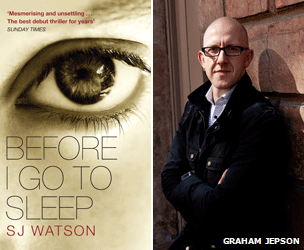
Before I Go to Sleep is being turned into a film by Ridley Scott
WHAT IS IT ABOUT? A psychological thriller. A woman has a rare form of amnesia and wakes up each morning with no memory of what happened the day before. But are things as they seem?
Asked how many copies of his book have been sold in Britain, Steve Watson first says he does not know then admits it is well over half a million. Almost half that number have been sold in e-book form – an unusually high proportion.
Ridley Scott is setting up the movie, reportedly with Nicole Kidman to star. Publication of his first book has been a life-changing event for the former NHS employee who used to work with hearing-impaired children in London.
“It’s a cliche but you can only really write for yourself. I had no audience in mind. In my case I’m sure it helped that I was doing a writer’s course at the time – the Faber Academy – so when things got really dark and I thought I couldn’t carry on there was someone to talk to.
“Even before the hardback came out the publishers sent out early copies. In retrospect that was really important. There’d be comments on Twitter or wherever and there was a really big word of mouth effect. People were talking about the book enthusiastically even before it was available to buy. There were also positive reviews on Amazon, which helped a lot, and luckily the book got good reviews in the newspapers too.
“Publishing is changing extremely quickly: e-readers are more and more important, especially for writers of so-called genre fiction such as thrillers or romances. I’m now doing some teaching and often people ask should they try independent self-publishing or stick with the traditional route? I tell them ‘just write the best book you can’. When I write I concentrate on the language and the words on the page. The publishing will happen if the book is good enough.”
GILLIAN FLYNN – GONE GIRL (US)
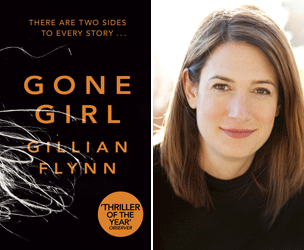
POSITION: 14th in US chart
WHAT IS IT ABOUT? A thriller with an emphasis on relationships. The narrative voice flips between a husband and wife as gradually we discover more about her mysterious disappearance. But whose statements can we trust?
Gillian Flynn (first name pronounced with a hard G) grew up in Missouri and worked as a journalist. She wrote for Entertainment Weekly in the States: “You leave the office in the middle of the day, go see a movie and talk and write about it. It was the perfect job.”
But by 2008 magazine publishing was changing and she got laid off. Gone Girl is her third novel. Fox acquired the movie rights and Flynn is writing the screenplay for Reese Witherspoon.
“My novels have all been dark psychological thrillers. But I think this one has taken off more than the others because it’s about relationships and marriage so the story has more entry points for readers. The rise of the internet has really changed publishing. There are blogs and websites and Twitter and Facebook and all those voices out there commenting on what you’ve just spent a year alone in your office writing.
“Today you know very quickly what people think about your work – and there was a big snowball-effect with this book on social media which gave it a real energy. It’s fun to dip in on those conversations… and then you dip back out for your own sanity!
“It’s not so much what people say they like or say they don’t like: what’s interesting is what they talk about online. There are certain passages of my book which have been re-posted endlessly: that’s when you know what actually grabbed people. So those online conversations are as important as the e-reader effect which everyone always mentions.
“E-books haven’t really changed the way I write. Though in one way they’re making reviews more important. People read a great review and then they buy the book 30 seconds later. Everything got quicker.”
To read more of the story from BBC News, click –> http://www.bbc.co.uk/news/entertainment-arts-21081397
