
News Date:Friday, January 25, 2013
By Dr Amjad Parvez
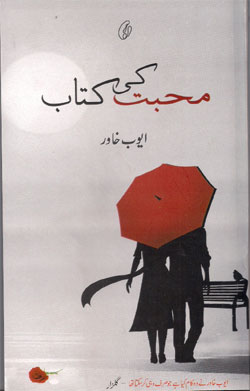
Muhabbat Ki Kitaab
By Ayub Khawer
Alqa Publications, Lahore; Pp 177
It is amazing the way Ayub Khawer has managed to converge his intrinsic quality of saying poetry and ability of drama production into one form; the book titled Muhabat Ki Kitaab. The book knits the story of a couple who meets on Valentine’s Day and gets separated on the same day a year later by becoming victims of terrorism. All the dialogues and even the narratives that move this story forward are in poetry form. Ayub Khawer has very pleasantly used some of his already said poetry during the discourse of the story. For example the first text message by Zafar Ehtasham to Sunbal Ifraz comprises Ayub’s famous ghazal, “Saat Suron Ka Behta Dariya Tere Naam/ Har Sur Mein Hei Rang Dhanak Ka Tere Naam” (the flowing river of seven notes is dedicated to you of which each note has colours of rainbow).
In the Western literature, the definition of a poetic drama is not merely a drama, which is written in verse, because prose may also be its effective medium. It is, in fact, a blending of the poetic and dramatic elements in a fruitful union. That is what Ayub Khawer has done in his book. Here poetry is an integral part of the play, twined with plot, character and their interplay. The poetry also retains a constituent of isolated beauty and lyricism for its own sake. The ghazal quoted above is independently a classic piece of love-poetry but has been effectively used. A parallel is the splendid lyricism in some parts of Marlowe’s Dr. Faustus. At the same time the dramatic elements are capable of sustaining the poetic elegance and strength. Ayub Khawer’s theme is very strong depicting the cruel disorder prevalent in the global scenario; terrorism. It means its themes and characters (only three living and the rest non-living like ocean and mirror etc) are poetically convinced and larger than the average humanity and humdrum boredom of daily life. The passions and emotions pervading them have the dynamism of the poetic expression, calculated to lift the mind of the reader above the bubble of our ordinary joys and sorrows. Ironically the history of the poetic drama in England is beleaguered with the frozen anatomies of poetic plays, many not being very successful. This reviewer can quote one example from not a very distant past (1987), a poetic drama titled ‘Bisaat’ by Basir Kazmi. It was a play in four acts with symbolic references to the political atmosphere in the country. It was in 1992 that Basir himself translated ‘Bisaat’ into English and gave it the title ‘The Chess Board’. It is probably the first long Urdu play to appear in an English translation.
The love poetry where all the dialogues, narratives, situations, locale, etc are expressed in poetry by Ayub Khawer deserves appreciation for its decency, simple expression and vocabulary. It is a story of a modern couple who starts their love accidentally by exchanging text messages in poetry form, meet traditionally in a restaurant where Juliet is to recognise her Romeo by a flower placed on his table. Sumbal is apprehensive to proceed for the meeting and talks to the mirror and says, “Yei Rishta Faqt messages Tak Ka Hargiz Nahin/ Dil Sei Dil Tak Ka Hei/ Dinon Ka Nahin Balke Sadion Ka Hei” (this relationship is not limited to messages, it is between the two hearts and spans on centuries not days) (page 91). The book takes a turn and comprises a beautiful section titled ‘collage of unforgettable moments of love’. The exchange of dialogues especially titled ‘muhabbat aab-o-daaney ki tarah sei hei’ (love is like water and grain), is full of expression of deep emotional attachment among the two. The sensitivities of emotions, unlike today’s love are marvellously expressed. It says ‘Muhabbat Inhi Sheheron Muhallon Aur Galion Tak/Aur Gharon Kei Aanganon Tak Khainch Laati Hei/Jehan Woh Palti Barhti Hei’ (Page 98) (Love strings exist in these cities, streets and homes where it grows). Ayub gets inspiration from great poets like Ghalib when he uses the terminology ‘Dortey Phirney’ (Ghalib’s line ‘Ragon Mein Doretey Phirney Kei Hum Nahin Qaail’ (I do not believe in blood just rushing in my veins). Ayub expresses Sumbal’s love through the line ‘Ragon Mein Doretey Phirtey Luhu Kei/Aik Ik Qatrey Kei Ander Dard Ki Soorat Phighalti Hei’ (love transcends inside each drop of blood like pain) ((Page 100).
A turn comes in the story when Sumbal who hails from a landlord family has to leave for her native village during summer vacations where she fails to resist her engagement with a relative chosen by her parents. On the seventh night, she opens many messages by Zafar where one is a voice message comprising a famous thumri of Bare Ghulam Ali Khan ‘Yaad Piya Kia Aye/Yei Dukh Saha Nahin Jaei’ (the memory of my beloved is so intense that it cannot sustain the pain) (page 118 – the remaining passages are new by Khawer).
Source: Daily Times
